
5 Things Every NSPB Consultant Should Know
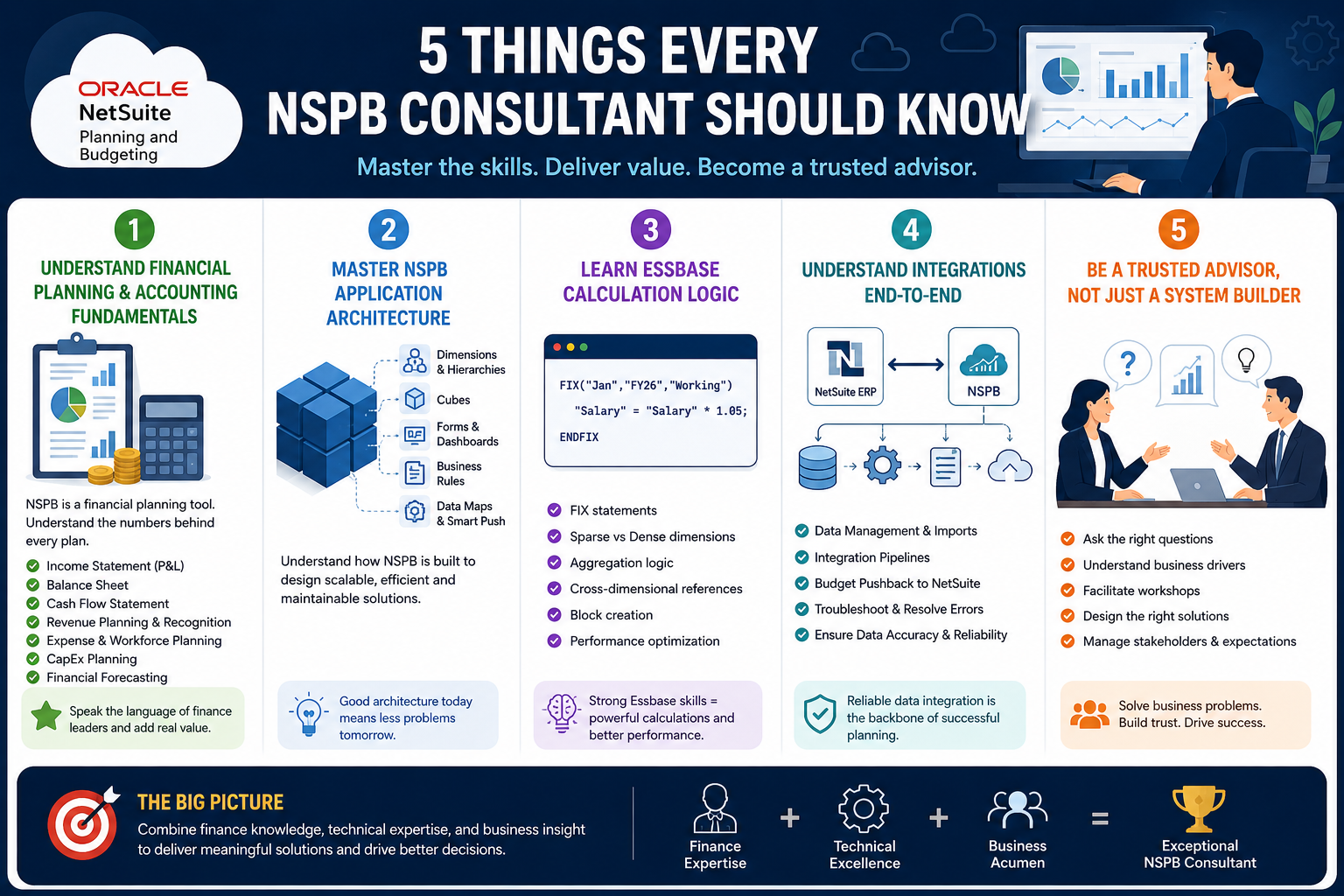
Oracle NetSuite Planning and Budgeting (NSPB) is a powerful cloud-based planning solution that enables organizations to streamline budgeting, forecasting, reporting, and financial planning processes. While learning the system's features is important, becoming a successful NSPB consultant requires a combination of technical expertise, financial knowledge, and business acumen.
Whether you're new to NSPB or looking to elevate your consulting career, here are five critical areas every NSPB consultant should master.
1. Understand Financial Planning and Accounting Fundamentals
One of the most common mistakes made by new consultants is focusing exclusively on the application while neglecting the underlying business processes. NSPB is ultimately a financial planning tool, which means consultants must understand the financial concepts that drive planning and budgeting activities.
A strong NSPB consultant should be comfortable discussing:
- Income Statements (Profit & Loss)
- Balance Sheets
- Cash Flow Statements
- Revenue Planning
- Expense Management
- Workforce Planning
- Capital Expenditure (CapEx) Planning
- Financial Forecasting
During implementation workshops, finance teams often describe their requirements in accounting and operational terms rather than technical language. Understanding these concepts allows consultants to translate business requirements into effective planning solutions.
For example, if a client reports that cash flow projections are inaccurate, the issue may not be a system configuration problem. Instead, it could be caused by missing balance sheet drivers, timing assumptions, or revenue recognition logic. Consultants who understand financial planning can identify root causes more quickly and provide strategic recommendations beyond system configuration.
Why It Matters
The best consultants speak the language of CFOs, FP&A managers, and finance leaders. When you understand financial planning processes, clients see you as a trusted advisor rather than simply a software administrator.
2. Master NSPB Application Architecture
Successful implementations require a deep understanding of how NSPB is structured behind the scenes. Consultants who understand application architecture can design scalable solutions, troubleshoot issues efficiently, and optimize system performance.
Key architectural components include:
Dimensions and Hierarchies
Dimensions are the foundation of every NSPB application. Common dimensions include:
- Account
- Subsidiary
- Department
- Class
- Location
- Relationship (Customer & Vendor)
- Item
- Scenario
- Tracker
- Index (Details cube specific)
- Employee (Workforc cube specific)
- Version
- Period
- Year
Understanding hierarchy design and member relationships is essential for building flexible planning models.
Cubes
Different planning processes may utilize separate cubes for:
- Plan Cube
- Workforce Cube
- Details Cube
Consultants should understand cube design principles and how data flows between cubes.
Forms and Dashboards
Forms serve as user input interfaces, while dashboards provide analytical insights. A consultant should know how to design intuitive user experiences that encourage adoption and improve planning efficiency.
Business Rules
Business rules automate calculations and planning logic. Proper rule design can significantly improve usability and reduce manual effort.
Data Maps and Smart Push
These features enable data movement across cubes and simplify planning workflows. Understanding when and how to use them is critical for larger implementations.
Why It Matters
A consultant who understands architecture can design applications that remain scalable and maintainable long after go-live.
3. Learn Essbase Calculation Logic
NSPB is built on Oracle Essbase, making calculation knowledge one of the most valuable technical skills an NSPB consultant can possess.
While many consultants can configure forms and dimensions, fewer understand how calculations work behind the scenes.
Important Essbase concepts include:
FIX Statements
FIX statements limit calculations to specific members and improve performance.
Example:
plaintext
FIX("Jan","FY26","Working")
   "Salary" = "Salary" * 1.05;
ENDFIX
Sparse vs Dense Dimensions
Understanding storage characteristics is critical for:
- Performance optimization
- Calculation efficiency
- Data storage management
Aggregation Logic
Consultants should know how parent-child rollups function and when aggregation issues may occur.
Cross-Dimensional References
Many planning calculations require referencing data across dimensions and intersections.
Block Creation
Understanding block creation behavior helps avoid missing data and calculation inconsistencies.
Performance Optimization
As applications grow, poorly designed calculations can significantly impact user experience. Consultants who can optimize calculations become invaluable to clients.
Why It Matters
Strong Essbase skills enable consultants to build sophisticated planning models while maintaining system performance.
4. Understand Integrations End-to-End
Data integration is often one of the most complex aspects of any NSPB implementation. Planning applications rarely operate in isolation; they depend on data from ERP systems, HR systems, CRM platforms, and external sources.
A skilled consultant should understand:
NetSuite ERP Integration
This includes:
- Data synchronization
- Metadata management
- Budget imports
- Actuals loading
- Budget pushback processes
Data Management
Consultants should know how to:
- Configure import formats
- Build data load rules
- Create mappings
- Validate imported data
- Troubleshoot load errors
Integration Pipelines
Understanding automated integration pipelines helps ensure reliable and repeatable data movement processes.
Error Troubleshooting
Many implementation delays occur because consultants cannot identify the source of integration failures. Knowing how to interpret logs and troubleshoot errors can save significant project time.
Why It Matters
Organizations rely on accurate and timely data. Consultants who understand integrations become critical resources during implementation and post-go-live support.
5. Become a Trusted Advisor, Not Just a System Builder
Technical skills alone are not enough to create successful projects. The most successful NSPB consultants are those who can guide clients toward better planning practices and strategic decision-making.
Clients rarely ask:
"Can you build a form?"
Instead, they ask questions such as:
- How should we structure our planning process?
- What drivers should we use for forecasting?
- How should workforce planning be managed?
- What level of detail is appropriate for budgeting?
- How can we improve forecast accuracy?
Answering these questions requires both technical and business expertise.
Key Consulting Skills
Requirements Gathering
Learn how to identify business needs and uncover hidden requirements.
Workshop Facilitation
Strong workshops lead to better solutions and stronger client relationships.
Solution Design
Consultants should be able to evaluate multiple approaches and recommend the most appropriate solution.
Stakeholder Management
Managing expectations is often just as important as building the system.
Why It Matters
Clients remember consultants who solve business problems, not consultants who simply configure software.
Final Thoughts
NSPB consulting is a unique combination of finance, technology, and business strategy. While technical knowledge is important, the most successful consultants develop expertise across all five areas:
- Financial Planning and Accounting Fundamentals
- NSPB Application Architecture
- Essbase Calculation Logic
- Integrations and Data Management
- Strategic Consulting and Advisory Skills
As artificial intelligence continues to transform the consulting industry, consultants who combine NSPB expertise with solution architecture, automation, and AI-driven planning capabilities will be positioned for long-term success.
The future belongs to consultants who can bridge the gap between finance, technology, and business transformation—not just configure applications.