
Can AI Replace NSPB Consultants? Not Yet—Here's Why
NSPBfy
Every few months someone publishes another piece about AI replacing finance professionals. The argument usually runs like this: AI can read financial data, generate forecasts, write code, and answer questions — so what exactly does a consultant do that a model can't?
It's a fair question, and if you're an NSPB consultant, you should be able to answer it clearly. Not defensively — clearly.
Here's the honest version.
What AI is genuinely good at in NSPB
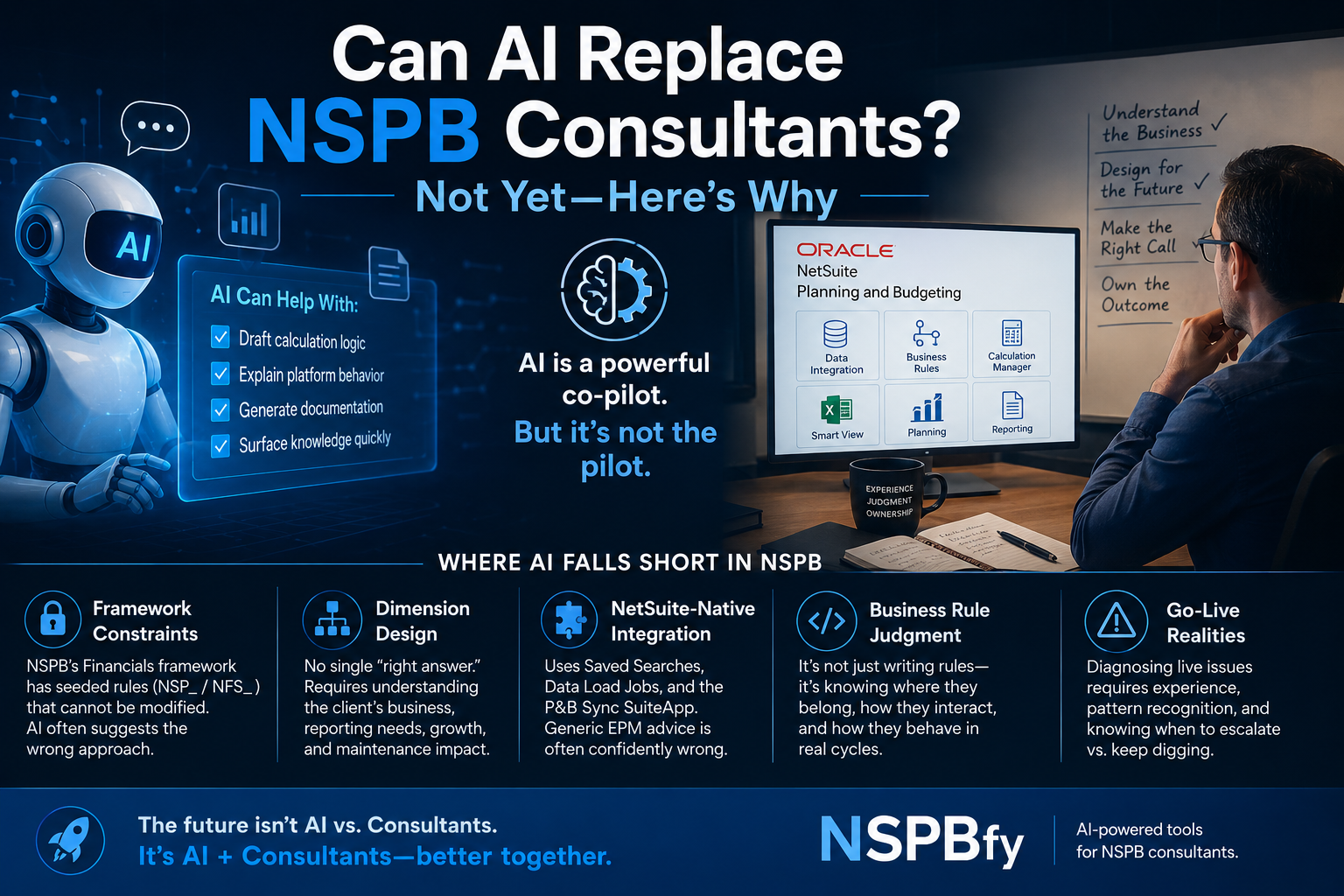
Let's give this its due. AI tools today can do real, useful work inside an NSPB engagement:
- Draft Essbase calculation logic. Give a model the requirement — "spread Annual to monthly using equal distribution, but only for Scenario = Budget and Version = Working" — and it can produce a reasonable FIX block or Calculation Manager formula component to start from.
- Explain platform behavior. Why does a FIX statement improve performance? What's the difference between a dense and sparse dimension? How does Smart Push differ from a Data Map? A well-prompted model can explain these accurately and clearly.
- Generate documentation artifacts. Meeting summaries, requirements matrices, test scripts, mapping tables — structured, repeatable documents that follow a template are exactly what language models do well.
- Surface relevant knowledge quickly. If a consultant has built a knowledge base of vetted NSPB content — actual configuration specifics, not hallucinated generics — AI can retrieve and surface it faster than any folder of Word docs.
None of that is trivial. That's hours per week on a real engagement.
Where it breaks down
The ceiling appears the moment NSPB-specific judgment enters the picture.
The Financials framework constraint. NSPB ships with a prebuilt application framework — seeded plan types and business rules prefixed with NSP_ and NFS_. You cannot overwrite those seeded rules. If a client needs custom calculation logic that conflicts with the delivered framework, the right answer isn't editing the seeded rule — it's creating a new plan type alongside it, or designing around the constraint entirely.
An AI that doesn't know this constraint exists will confidently suggest the wrong thing. It will tell you to modify the delivered rule. A consultant who's been burned by that once never forgets it.
Dimension design decisions don't have a "right answer." Should this client put Class and Location as separate custom dimensions, or roll them into a combined segment? Should Department stay flat or carry a rollup hierarchy that mirrors the org chart? What happens to historical data if the hierarchy changes mid-year?
These questions require understanding the client's NetSuite segment structure, their reporting requirements, their tolerance for maintenance overhead, and their likely growth trajectory — then making a judgment call that the client will live with for years. AI can enumerate the tradeoffs. It can't make the call, and more importantly, it can't own it.
NSPB's integration path is NetSuite-native in ways that break generic EPM advice. The actual integration mechanism is a Saved Search on the NetSuite side — literally named with "Data" or "Metadata" in the search title — executed by a Data Load Job via the Planning and Budgeting Sync SuiteApp. When a load fails, you're debugging a saved search filter condition or a SuiteApp authentication issue, not an Oracle Data Management import format.
Ask a general-purpose AI to help troubleshoot a failed NSPB data load and it will walk you through FDMEE screens that don't exist in this context. It's confidently wrong in a way that wastes an hour before you realize it.
Business rules require understanding the model, not just the syntax. Writing a valid Groovy business rule or a well-structured Calculation Manager graphical rule isn't the hard part. The hard part is knowing which plan type it belongs to, which dimension intersections it should touch, how it interacts with the seeded framework rules that run before it, and whether it will behave correctly during a mid-year forecast versus an annual budget cycle. That context lives in the consultant's head — built from weeks of design sessions with the client. An AI working from a single prompt has none of it.
Go-live is a judgment problem, not a knowledge problem. The week before go-live, things break in unexpected combinations. A Data Load Job that worked fine in UAT fails with live credentials. A business rule that calculated correctly in the test environment produces zeros against production actuals data. Smart View connections work for some users and not others.
Diagnosing those failures fast requires pattern recognition across a specific combination of NSPB, NetSuite, Smart View, and the client's own infrastructure — not general troubleshooting heuristics. It also requires knowing when to escalate to Oracle support versus when to keep digging. That judgment is experience, not knowledge retrieval.
The argument some people don't want to hear
The consultants most at risk from AI aren't the deep specialists. They're the ones doing the part of the job that was always shallow: filling in templates, reading Oracle documentation to a client, configuring screens by following a checklist.
If your value is "I know where the buttons are," AI gets there faster and cheaper. If your value is "I understand how this client's business works and I can build a model that reflects it accurately and stays maintainable," that's a harder ceiling to reach.
NSPB specifically is a platform that rewards depth. The Financials framework constraints, the NetSuite-native integration path, the Hybrid BSO performance behavior, the interplay between seeded and custom rules — these aren't things you learn from documentation. They're things you learn from implementations that didn't go perfectly. A model trained on generic Oracle EPM documentation doesn't have that scar tissue.
What the combination actually looks like
The realistic outcome isn't replacement. It's leverage.
A consultant who uses AI well finishes the documentation pass in half the time, has a first draft of a calc script ready before the design session instead of after, and can answer client questions in the meeting instead of following up by email the next morning.
What that means in practice is that a single consultant can cover more of an engagement without quality dropping — or deliver an engagement faster without cutting corners. That's not AI replacing the consultant. That's the consultant getting significantly better at the job.
The consultants who will feel pressure aren't the ones who learned NSPB deeply. They're the ones who didn't — and relied on the information asymmetry between themselves and the client to make up the gap.
The short answer
Can AI replace an NSPB consultant? Not the kind that knows the platform well enough to design around its constraints, debug a live integration failure, and make the dimension design call that the client will be living with in three years.
Can AI replace parts of what NSPB consultants do today? Absolutely, and anyone pretending otherwise is ignoring real tooling that already exists.
The consultants who will thrive are the ones who use that tooling — and spend the time they get back going deeper on the parts AI can't reach yet.
© 2026 NSPBfy.com — AI-powered tools for NSPB consultants