
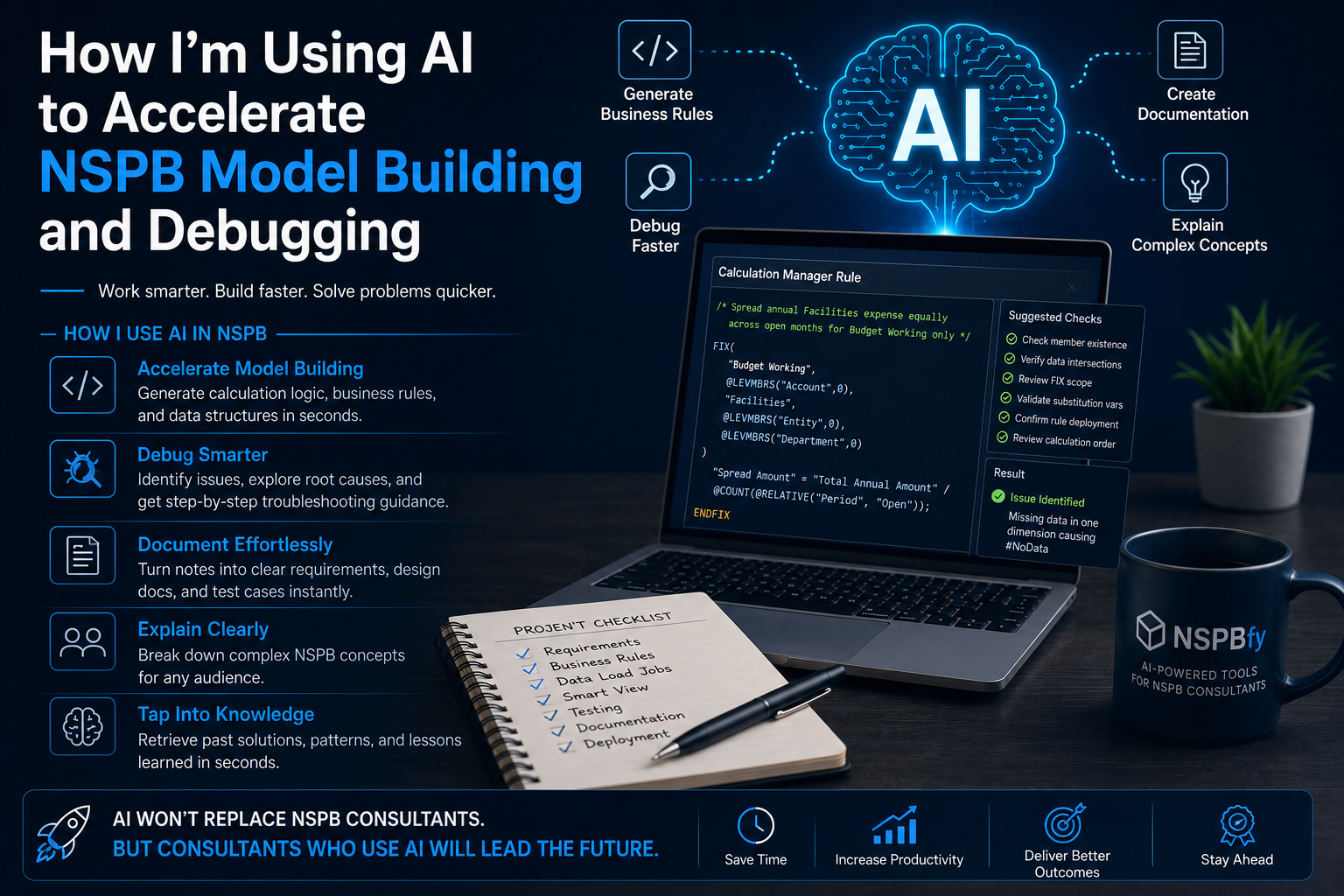
How I'm Using AI to Accelerate NSPB Model Building and Debugging
NSPBfy
When people hear "AI for NSPB," they usually imagine a chatbot answering finance questions.
That's not how I use it.
I don't use AI to replace my consulting work. I use it to remove the friction around it.
After more than seven years working with Oracle Hyperion, PBCS, and NSPB, I've learned that the hardest part of an implementation is rarely the technical build itself. It's the thousands of small tasks surrounding it: finding documentation, recalling a business rule you wrote six months ago, troubleshooting an issue under time pressure, documenting design decisions, and translating business requirements into technical solutions.
Those tasks don't create value by themselves. They consume time that could be spent solving the client's actual problem.
That's where AI has become one of the most useful tools in my consulting toolkit.
The old way: starting from a blank page
Every NSPB consultant knows this scenario.
A client asks for a new workforce allocation logic.
You already know how it should work conceptually, but you still need to:
- Open previous projects
- Find a similar business rule
- Review Calculation Manager logic
- Check syntax
- Verify dimensions
- Write documentation
- Create test cases
The actual thinking takes twenty minutes.
The surrounding work takes three hours.
AI doesn't eliminate the thinking.
It eliminates much of the setup work.
Today I can describe the requirement in plain English and get a draft calculation approach immediately. It's not production-ready, but it gives me a starting point instead of a blank screen.
That matters more than people realize.
Accelerating business rule development
One of my most common uses of AI is drafting calculation logic.
For example, I might tell it:
"Create logic to spread annual Facilities expense equally across open months for Budget Working only."
Within seconds I have a framework to review.
The important part isn't that AI writes the rule.
The important part is that I no longer spend fifteen minutes typing boilerplate FIX statements and validating basic syntax.
My job becomes reviewing and improving the solution rather than creating it from nothing.
The difference sounds small.
Across hundreds of rules, it adds up quickly.
Debugging faster when things break
Every consultant eventually receives a message like:
"The business rule isn't calculating."
That's usually all the information you get.
The actual problem could be:
- Wrong member selection
- Missing data intersection
- Security issue
- Substitution variable problem
- Metadata change
- Rule deployment issue
- Incorrect FIX scope
Traditionally, troubleshooting starts with opening logs and manually checking possibilities one by one.
Now I often use AI as a troubleshooting partner.
I explain:
- The symptom
- The affected dimensions
- The recent changes
- The expected result
AI can quickly suggest potential root causes and provide a structured debugging checklist.
It doesn't magically know the answer.
But it helps ensure I don't overlook something obvious while under pressure.
Explaining NSPB concepts instantly
One challenge in consulting is context switching.
One hour you're discussing workforce planning.
The next hour you're explaining Smart View behavior to a finance analyst.
Then you're talking to an IT administrator about integrations.
AI helps bridge those transitions.
Need to explain:
- Sparse vs dense dimensions?
- Smart Push vs Data Maps?
- Data Load Jobs?
- Alternate hierarchies?
- Groovy rules?
I can generate a client-friendly explanation in seconds and adapt it to the audience.
The technical accuracy still requires review.
But the communication becomes dramatically faster.
Documentation no longer takes days
Let's be honest.
Most consultants don't enjoy writing documentation.
Yet every project requires:
- Requirements matrices
- Design documents
- UAT scripts
- Training materials
- Hypercare summaries
- Meeting notes
AI is exceptionally good at structured documentation.
After workshops, I can turn rough notes into organized documentation almost immediately.
Instead of spending an afternoon formatting documents, I spend my time validating the content.
Clients get better documentation.
I spend less time creating it.
Everyone wins.
The biggest productivity gain isn't coding
People often assume the biggest AI benefit is writing scripts.
For me, it's knowledge retrieval.
Every consultant accumulates years of project knowledge:
- Lessons learned
- Design patterns
- Workarounds
- Common issues
- Oracle support findings
The problem isn't collecting knowledge.
The problem is finding it when you need it.
I might remember solving a Smart View issue eighteen months ago but not remember which project it was.
AI changes that.
Instead of searching folders and emails, I can ask a question and retrieve the relevant information almost instantly.
That alone saves hours every month.
Where AI still struggles
Despite all the benefits, there are limits.
AI doesn't understand the client.
It doesn't attend workshops.
It doesn't know why a dimension was designed a particular way.
It doesn't understand the political realities inside an organization.
Most importantly, it doesn't own the consequences of design decisions.
Should Department be a custom dimension?
Should the model prioritize flexibility or performance?
Should a client accept additional maintenance complexity for better reporting?
Those decisions require judgment.
And judgment comes from experience.
Not prompts.
Why I built Cy AI
The more I used AI personally, the more I realized something.
Generic AI is helpful.
NSPB-specific AI is transformative.
Most AI tools understand programming.
Very few understand:
- Financials framework constraints
- NSP_ seeded business rules
- NetSuite Planning and Budgeting integrations
- Smart View workflows
- Workforce module behavior
- Revenue planning design patterns
That's why I started building Cy AI.
Not as another chatbot.
As a consultant's toolkit.
A system grounded in NSPB-specific knowledge that helps consultants build faster, troubleshoot smarter, and preserve institutional knowledge across projects.
The goal isn't replacing consultants.
The goal is removing low-value work so consultants can spend more time doing what clients actually hire them for: solving business problems.
The future of NSPB consulting
The consultants who worry most about AI are usually thinking about replacement.
The consultants benefiting most from AI are thinking about leverage.
Every year NSPB implementations become more complex.
Finance teams expect faster delivery.
Projects have tighter timelines.
Clients want answers immediately.
AI helps meet those expectations.
Not because it replaces expertise.
Because it amplifies it.
The future isn't AI versus NSPB consultants.
It's NSPB consultants using AI versus those who aren't.
And from what I've seen so far, that's a competition that won't stay close for long.
Cy AI is an AI-powered toolkit built specifically for NSPB consultants. Designed to accelerate model building, troubleshooting, documentation, and knowledge retrieval — so consultants can spend less time searching and more time delivering value.
© 2026 NSPBfy.com — AI-powered tools for NSPB consultants