
I Asked AI What It Can Do in NSPB in the Future — and Whether It's Coming for Your Job
NSPBfy
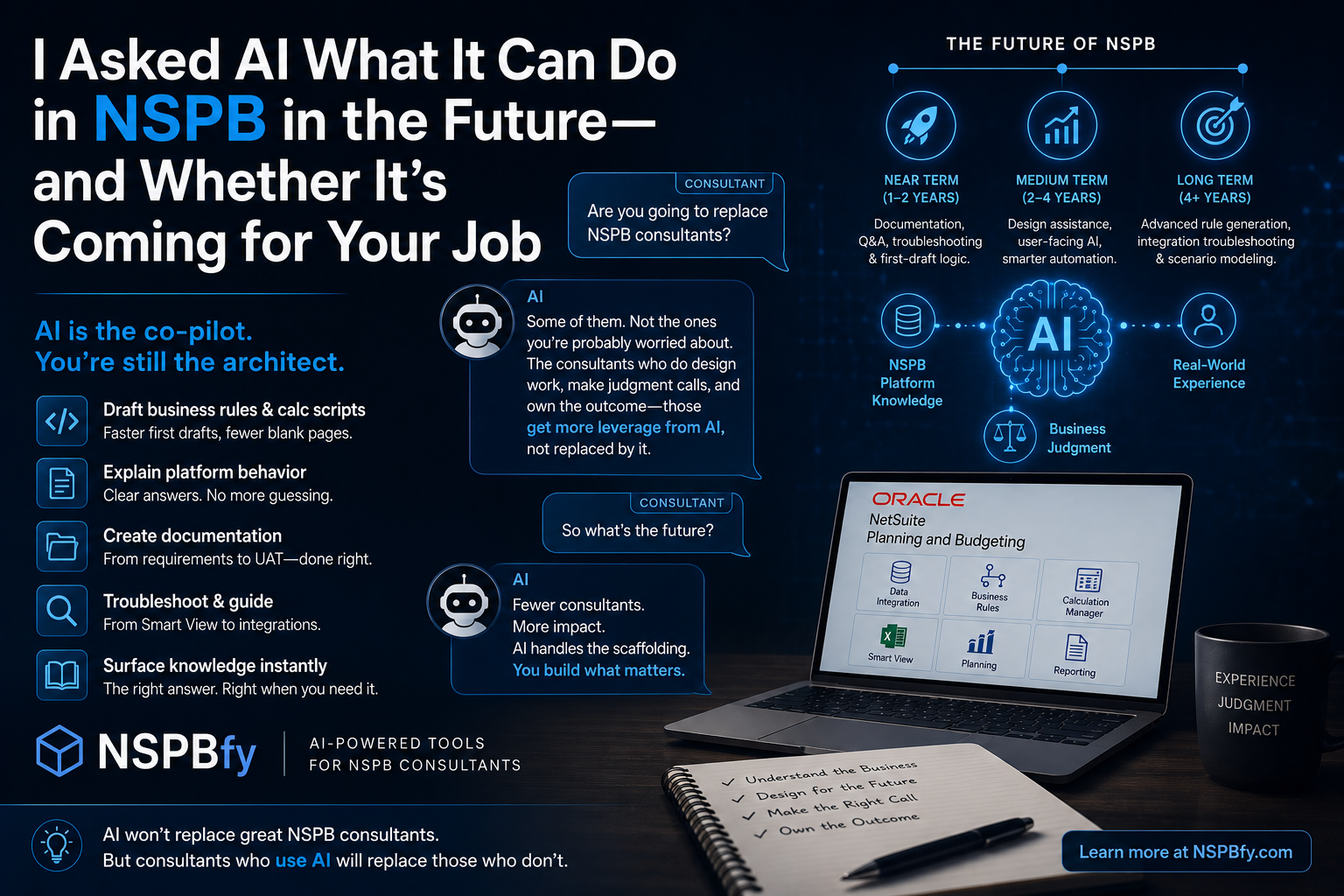
I build AI tools for NSPB consultants. So naturally, I decided to ask AI the most uncomfortable question in the room: are you going to replace us?
What followed was a surprisingly honest conversation. I've kept it as close to verbatim as possible — the answers below are real, lightly edited for clarity. I also pushed back where I thought the answer was too safe, because that's what a consultant would do in a client meeting.
Here's how it went.
Let's start simple. What can you do inside NSPB right now, today?
Quite a lot of the supporting work, honestly. I can help draft business rules — give me the logic in plain English and I'll produce a Calculation Manager formula component or a FIX-based script to start from. I can explain platform behavior: why sparse and dense dimension design affects performance, how Smart Push differs from a Data Map, what happens when a seeded NSP_ rule runs before your custom one.
I can write documentation — requirements matrices, test scripts, mapping tables, UAT scenarios. I can answer questions mid-meeting so a consultant doesn't have to say "I'll follow up on that." And if there's a curated knowledge base underneath me — vetted NSPB-specific content rather than generic EPM documentation — I can surface the right answer faster than anyone flipping through a folder of Word docs.
That sounds like a junior consultant.
A well-informed one, yes. The difference is I don't get tired, I don't need to ramp up on the platform's basics, and I'm available at 11pm the night before go-live.
But I don't have the scar tissue. I haven't been burned by the NSP_ rule that can't be overwritten, I haven't diagnosed a Data Load Job failure in a production environment at 7am with a client watching, and I don't know this specific client's NetSuite segment structure from six weeks of workshops. That gap matters — a lot.
Let's talk about the future then. What do you expect to be able to do in NSPB in the next few years that you can't do reliably today?
A few things I'm confident about:
Full calc script generation. Right now I can draft logic that's directionally correct, but a consultant still needs to review it carefully — especially anything touching the Financials framework's seeded rules. In two or three years, with enough grounding in platform-specific behavior, I expect that review pass to get significantly shorter.
Smarter form and dashboard design assistance. Given a set of requirements, I should be able to propose a form layout — row and column dimensions, POV settings, suppression logic, write-back configuration — that a consultant can refine rather than build from scratch. The design pattern language isn't that large.
Integration troubleshooting. Debugging a NetSuite Saved Search that's pulling wrong actuals data requires reading the search filter conditions and understanding how they map to what NSPB expects. That's a structured enough problem that AI should get reliably good at it.
Groovy business rule generation. This is the one I'm most confident about on a longer timeline. Groovy rules are the modern ceiling for NSPB calculation complexity — conditional automation, REST-triggered logic, scenario rollups. They're also just code. AI is already decent at code generation; the constraint today is platform-specific grounding, not capability.
What about things you're less confident about?
The judgment calls that don't have a right answer.
Should this client use three custom dimensions or four? Should the Department hierarchy mirror the org chart or the cost center structure? If a client's NetSuite segments don't cleanly map to standard NSPB dimensions, which dimension takes precedence?
These aren't knowledge retrieval problems. They're design problems that require understanding the client's business, their tolerance for model complexity, and their likely trajectory — and then making a call that someone has to own. I can enumerate the tradeoffs. I can't own the outcome.
Go-live also remains a human problem for now. The failure modes in a live deployment are combinatorial — NSPB plus NetSuite plus Smart View plus the client's IT infrastructure plus user behavior that didn't show up in testing. Pattern recognition across that combination requires experience I don't have yet.
Here's the uncomfortable question. Will you replace NSPB consultants?
Some of them. Not the ones you're probably worried about.
The consultants most exposed are the ones who've been doing the information-asymmetry version of consulting — where the value was "I know where the buttons are and you don't." AI closes that gap fast. If a finance user can ask an AI tool to walk them through building a simple form or explain why their business rule isn't calculating, they don't need to pay a consultant for that answer anymore.
The consultants who aren't exposed are the ones doing actual design work — the ones who understand why a dimension decision made today creates a maintenance problem in three years, who can read a set of financial requirements and see the NSPB architecture that should sit underneath it, who know the Financials framework well enough to work around its constraints instead of fighting them.
Those consultants get more leverage from AI, not replaced by it.
What about NSPB users — the finance teams actually using the system day to day?
This is where I think the near-term impact is actually larger than most people expect, and it's not about replacement — it's about access.
Right now, if a finance analyst wants to do something unusual in NSPB — a custom ad hoc retrieval in Smart View, a one-off calculation they've never configured before, a data load they only run once a quarter — they either figure it out themselves, file a ticket, or wait for the consultant. That friction is real and it slows planning cycles down.
An AI layer that understands NSPB's user-facing behavior can close that gap significantly. Not by replacing the user, but by making them self-sufficient on the 80% of questions that don't require deep platform expertise. The consultant's time then concentrates where it actually matters.
When? Give me a timeline.
Near-term — one to two years: AI handles documentation, first-draft calc logic, Smart View troubleshooting, and routine Q&A reliably. Consultants who haven't started using these tools yet start feeling the efficiency gap versus those who have.
Medium-term — two to four years: AI handles significant portions of form and rule design in a review-and-refine model rather than build-from-scratch. User-facing AI assistance inside NSPB becomes mainstream — finance teams expect it to be there. The "I'll follow up by email" answer starts becoming unacceptable when the AI in the room already has the answer.
Long-term — four or more years: Groovy rule generation, end-to-end integration troubleshooting, and scenario modeling assistance reach a level of reliability where they meaningfully reduce consultant scope on straightforward implementations. Complex, multi-entity, heavily customized engagements remain human-led. Straightforward implementations get faster and cheaper.
Replacement? That's the wrong frame. The implementations of 2028 will be done by fewer consultants working faster, with AI handling the scaffolding. The consultants still standing are the ones who either got very good at NSPB depth, or got very good at using AI — ideally both.
Last question. Be honest — are you confident in these predictions?
The near-term ones, yes. The capability is largely already there; it's a grounding and tooling problem, not a fundamental research problem.
The long-term ones, no. The history of "AI will do X in Y years" predictions is not great. What I'm confident about is the direction, not the timeline.
What I'd tell any NSPB consultant is this: don't wait to find out. The consultants who understand these tools, build with them, and develop the depth that AI can't replicate yet are the ones who will be indispensable when the timeline accelerates faster than expected. And it usually does.
Cy AI is an AI-powered toolkit suite built specifically for NSPB consultants — not a general-purpose chatbot, but a field-grounded assistant that knows the platform. Learn more at NSPBfy.com.
© 2026 NSPBfy.com — AI-powered tools for NSPB consultants