
The Rolloff Problem: What Happens to Implementation Knowledge When the Consultant Leaves
NSPBfy
There's a moment in every NSPB implementation that nobody talks about in the kickoff meeting.
It happens somewhere between the go-live celebration and the end of hypercare. The consultant — the person who designed the dimension model, wrote the business rules, built the integration mapping, facilitated the design sessions, and made a hundred small decisions that shaped how the system behaves — packs up their access and rolls off the project.
And everything they know leaves with them.
Not maliciously. Not carelessly. Just inevitably. Because the kind of knowledge that makes an NSPB implementation actually work isn't the kind that fits neatly into a handover document.
What a handover document actually captures
Most implementations end with some version of a technical design document, a configuration workbook, a training guide, and maybe a recorded walkthrough video. If the consultant is thorough, there's an admin runbook too.
These are useful. They're not sufficient.
Here's what a handover document captures well: what was built. The dimension structure, the plan types, the form layouts, the business rule names, the integration schedule.
Here's what it almost never captures: why it was built that way.
Why is the Department dimension flat instead of hierarchical? Because in week three, the client's org chart changed and the CFO decided mid-project that rollup reporting would live in NetSuite instead of NSPB — but that decision isn't in any document, it's in the consultant's memory of that Tuesday call.
Why does the CapEx form exclude Entity 105? Because Entity 105 was mid-acquisition during implementation and the client said "we'll add it after close" — but the acquisition never happened, and now nobody knows if the exclusion was intentional or an oversight.
Why does the Workforce business rule only apply to the headcount accounts and not the contractor lines? Because there was a three-hour workshop in week six where the FP&A director and the controller disagreed about how contractor costs should flow, they reached a compromise, and the consultant built exactly that compromise — but the only record of it is the consultant's notes from that session.
This is the rolloff problem. Not the absence of documentation. The absence of context.
Why the client can't reconstruct it
The NSPB admin who inherits the system post-go-live is usually smart, capable, and completely out of their depth when something unexpected happens — not because they didn't pay attention during training, but because training covers the 40% of the system that's intuitive. The other 60% — the why behind every technical decision — was never theirs to know in the first place.
When a business rule stops calculating correctly after a dimension member was renamed, they don't know whether to re-deploy the rule, check the FIX statement members, look at the Calculation Manager graphical view, or call Oracle support. They know the outcome is wrong. They don't know the mechanism well enough to trace it.
When a new cost centre needs to be added to NSPB and it's not pulling into the right rollup, they don't know whether the problem is in the dimension hierarchy, the security filter, the data load mapping, or the NetSuite Saved Search that feeds the metadata sync. They don't know what they don't know.
And when they do call the original consultant — if that consultant is still reachable, still at the same firm, still in the same practice — the consultant has to reconstruct from memory what they built eighteen months ago, for a client they haven't thought about since rolloff. That call takes two hours and costs everyone something.
The knowledge that actually matters post-go-live
After years of NSPB engagements, the questions that break clients post-go-live fall into a predictable pattern. They're almost never "how does NSPB work." They're always "how does our NSPB work."
- Why does this rule behave differently for Budget versus Forecast?
- What was the logic behind the way this account rolls up?
- Why can't I add this member here — is that by design or a bug?
- When we close December, what exactly do we need to do and in what order?
- This number doesn't match NetSuite. Where does it come from?
None of those questions have generic answers. They have answers specific to that client's application — answers that exist somewhere in the combination of workshop notes, design decisions, change log entries, and the consultant's working memory.
When the consultant leaves, most of that answer set leaves too.
What actually needs to survive rolloff
Not more documentation. A different kind of documentation.
The design decisions — not just what was decided, but why, and what the alternatives were. The meeting notes from every session where a fork in the road was reached and a direction was chosen. The change log — every time something was modified after it was first built, and the reason it changed. The business rule logic explained in plain language alongside the technical implementation. The integration mapping with the edge cases and exceptions called out, not just the happy path. The workarounds — because every implementation has them — and the rationale behind each one.
This is the institutional memory of an implementation. And the problem with institutional memory is that it's only valuable if it's accessible — not buried in a folder of meeting notes that nobody knows exists, not locked in a Confluence page that the client doesn't have access to, not sitting in the consultant's Outlook archive.
It needs to be searchable, specific, and available at the moment someone needs it — which is usually not a comfortable moment.
What we're building to solve this
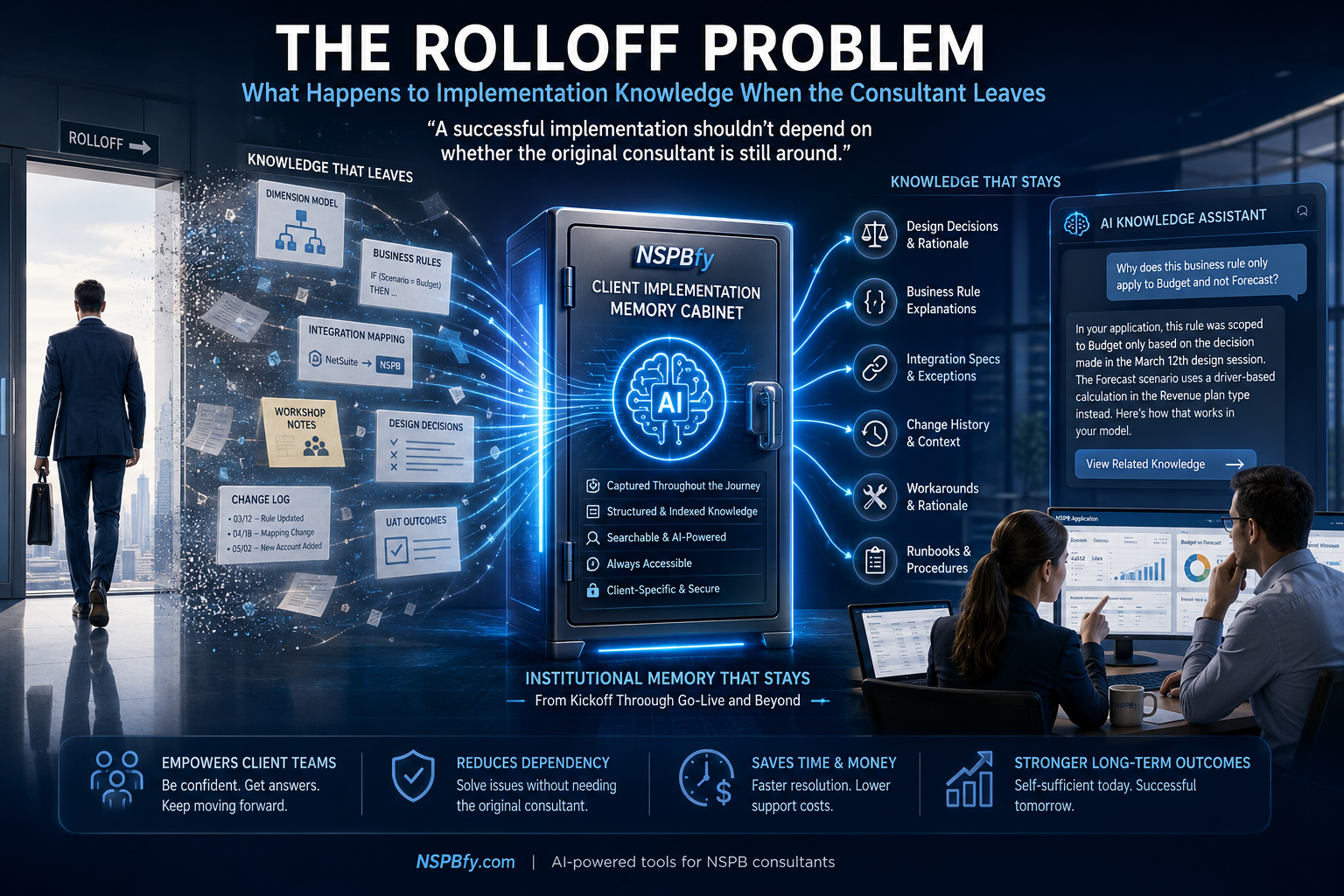
This is the problem that the Client Implementation Memory Cabinet in NSPBfy is designed to address.
The idea is straightforward even if the execution isn't: throughout the implementation, everything gets captured and fed into a client-specific knowledge layer. Meeting notes, design decisions, business rule explanations, change log entries, integration specs, UAT outcomes, go-live runbook. Not as a document archive — as structured, indexed, searchable knowledge that an AI can draw from.
So when the client admin asks "why does this business rule only apply to Budget and not Forecast" — they don't get a generic explanation of how FIX statements work. They get the actual answer: "In your application, this rule was scoped to Budget only because of the decision made in the March 12th design session. The Forecast scenario uses a driver-based calculation in the Revenue plan type instead. Here's how that works in your model."
That's not a chatbot. That's the institutional memory of the implementation, made accessible.
The goal isn't to replace the consultant during the project — the judgment, the workshop facilitation, the architectural decisions still require a human who understands both the platform and the client's business. The goal is to make sure that when the consultant leaves, what they built and why they built it doesn't leave with them.
Because the client signed up for a planning system that works. Not for a planning system that works as long as the right person is still on retainer.
What this means for consultants
If you're a consultant reading this, the rolloff problem is also yours — not just the client's.
Every time a client calls you twelve months after rolloff because something broke and nobody can explain why, that's time you're spending at a rate that probably doesn't reflect the value of the call. Every time a client churns silently because the system became unmanageable after handover and they didn't know how to ask for help, that's a reference you didn't get and a renewal that didn't happen.
The implementations that generate long-term client relationships aren't the ones that go live on time and on budget. They're the ones where the client is still self-sufficient two years later — where the system still makes sense without the consultant in the room, because the knowledge of how and why it was built is still accessible.
That's not a nice-to-have. That's the difference between a successful implementation and an expensive one.
The Client Implementation Memory Cabinet is part of NSPBfy's roadmap — a per-client AI layer that carries the institutional knowledge of an implementation forward, from kickoff through go-live and into ongoing operations. It's being built because the rolloff problem is real, predictable, and solvable — and because clients deserve more than a folder of documentation and a good luck.
© 2026 NSPBfy.com — AI-powered tools for NSPB consultants