
Why NSPB Implementations Fail After Go-Live — The User Adoption Problem Nobody Talks About
NSPBfy
I'm going to say something that doesn't get said enough in NSPB consulting circles.
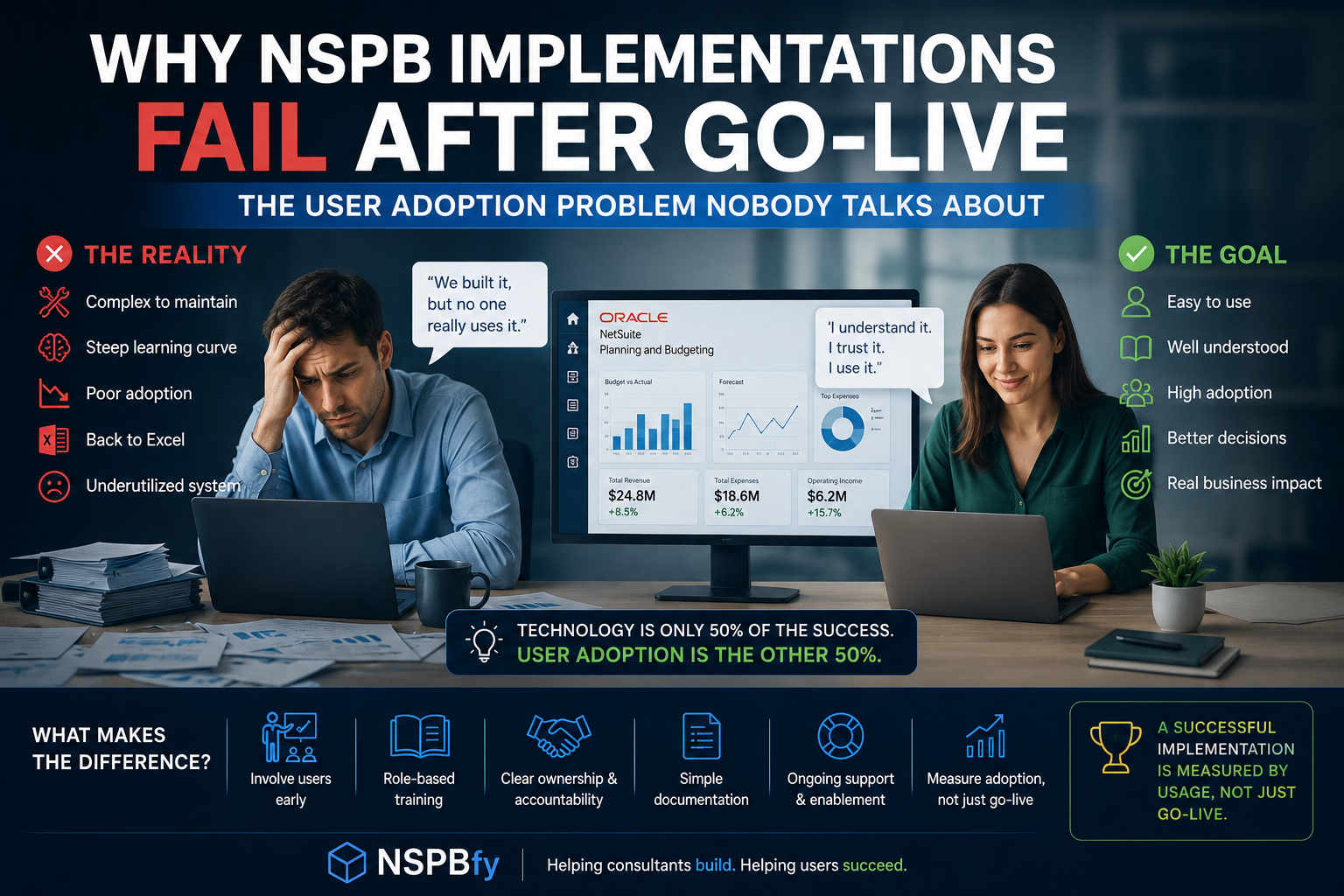
We build a system, hand it over, and call it a successful implementation. Then six months later the client is barely using half of it, the admin is overwhelmed, and the finance team has quietly gone back to Excel. And we wonder why.
The honest answer isn't the system configuration. It's that we handed a platform that is 40% intuitive and 60% technical to a person whose job title is Senior Financial Analyst — not System Administrator.
Let's be honest about what NSPB actually is to use
When finance teams see an NSPB demo, they see the 40%: clean input forms, dashboards, scenario comparisons, one-click reports. It looks like a finance tool. It looks like something they can run.
What they don't see in the demo is the 60%:
- Business rules that need to be understood, maintained, and occasionally rewritten when the model changes
- Dimension member additions that have to be done in the right order across plan types or data breaks
- Data Load Jobs that fail silently and require someone who can read a log file to diagnose
- Smart View connections that behave differently per user, per machine, and per version of the Office add-in
- Budget templates that stop working after a metadata refresh because a member name changed
- Calculation Manager rules that need to be re-deployed after changes — and if you forget to deploy, nothing updates and nobody tells you why
- Security filters that break when someone moves teams and nobody thinks to update their role assignment
- Application maintenance tasks — clearing blocks, running database refresh, managing substitution variables — that need to happen on a schedule and aren't automatic
None of that is unreasonable for a platform of this depth. But none of it is intuitive to someone who has spent their career in Excel, NetSuite, and financial modeling — which is exactly who gets handed the admin keys at go-live.
This isn't the client's fault
Let's be clear about something before we go any further: we don't blame the client for not understanding the technical side of NSPB. Why would they? They didn't sign up for it.
A client signs an implementation contract because they want better budgeting, cleaner forecasts, and less time spent consolidating spreadsheets. They did not sign up to understand Essbase block storage, Groovy scripting, or why a Calculation Manager rule needs to be explicitly deployed after every change. That was never the deal.
And yet we consistently set expectations — sometimes unconsciously — as though it were. We train them on the system at go-live, hand over a documentation folder, and assume the 60% technical layer will somehow become second nature to a finance team that has other full-time jobs to do.
Here's the part that's even harder to say honestly: even consultants only deeply understand 10–20% of the full business rule logic in a complex NSPB build. Not because they're not good at their jobs — but because a mature NSPB application accumulates layers. Rules built in phase one interact with rules added in phase two. Seeded framework rules from Oracle run before your custom rules in ways that aren't always documented. Groovy scripts handle edge cases that were designed six months ago by someone who has since rolled off the project.
No single person holds the complete picture. It lives in a combination of the build artifacts, the design decisions, the meeting notes, the change log, and the memory of the people who were in the room when the decisions were made.
When the consultant leaves, most of that walks out the door with them.
Who actually ends up as the NSPB admin
On most mid-market NSPB implementations, the system admin post-go-live is someone from the FP&A team or the accounting team. Not IT. Not a technical resource. Someone who was the "most engaged" stakeholder during the project — the one who asked good questions in workshops, showed up to every UAT session, and genuinely wanted the system to succeed.
That person is now responsible for:
- Adding new cost centers when the org restructures
- Rebuilding a business rule when the calculation logic changes for next year's budget
- Troubleshooting a Data Load Job that stopped pulling actuals correctly after a NetSuite saved search got modified by someone on the ERP side
- Answering "why is my Smart View showing #NoData" for twelve different users
- Managing the annual budget cycle setup — copying versions, opening periods, resetting forms
This is not an accounting job. This is a system administration job wearing an accounting job's clothing. And we set it up this way by default, because most clients don't budget for a dedicated technical admin and most consultants don't push back hard enough on that decision during implementation planning.
Why training doesn't solve it
The standard response to this problem is "more training." We build end-user guides, we run admin training sessions, we document the build. Some of us even record walkthrough videos.
And it still doesn't stick. Here's why.
Training delivered at go-live is training delivered at the worst possible moment. The admin is already overwhelmed by the transition. The system is live, real data is in it, real people are depending on it, and the consultant is ramping off. Retention from a three-hour admin training session under those conditions is not high.
Then six months later, when the admin actually needs to add a new department member, they can't remember the exact sequence — which plan types need updating, whether the hierarchy needs a refresh, whether the business rule needs redeployment. The documentation exists somewhere. Finding it, reading it, and applying it correctly under pressure is a different skill than receiving it in a workshop.
And that's assuming nothing has changed since go-live. When the org restructures, when a new budget cycle starts, when a NetSuite update changes a field name that was mapped in a Saved Search — the training materials are already out of date.
We can't expect a non-technical client to internalize Essbase or understand Groovy scripting from a training session. That's not a failure of the client. That's a failure of how we've been designing the handover.
The gap nobody budgets for
What NSPB clients actually need post-go-live isn't more training. It's lower-friction access to the right answer at the moment they need it — an answer that's specific to their system, not generic NSPB documentation.
When the Data Load Job fails at 8am on a Monday and the FP&A manager is trying to run the monthly actuals load before the 9am budget meeting — they don't need to open a 40-page admin guide. They need to know, right now, whether the issue is the Saved Search filter, the SuiteApp authentication, or the NSPB data load mapping. And they need that answer in plain language, not Oracle documentation.
When a new entity gets added to NetSuite and the admin needs to add it to NSPB — they don't need to remember which of the twelve steps they're likely to miss. They need a guided, client-specific checklist that accounts for exactly the way their application was built — not a generic best-practice document.
This is the gap that most implementations leave open. The consultant closes their project, the hypercare period ends, and the client is left with a system that requires ongoing technical judgment from people who were never equipped to exercise it.
Why I built Cy AI — and what it's actually trying to do
This is the problem that led me to build NSPBfy.
Not "AI for NSPB" in the abstract. Specifically this: the moment the consultant leaves, the institutional knowledge of the implementation leaves with them. The design decisions, the meeting notes, the "we decided to do it this way because of X" context that explains why the system behaves the way it does — all of it either lives in someone's memory or in a folder of documents that nobody navigates back to.
What I'm building toward is an AI that doesn't just know NSPB generically — it knows your NSPB.
The idea is to document everything throughout the implementation: meeting notes, design decisions, business rule logic, dimension choices, integration mapping, UAT outcomes, change log, go-live runbook. All of it gets fed into a client-specific knowledge layer that sits underneath Cy AI. Instead of getting a vanilla NSPB answer when you ask why a rule isn't calculating correctly, you get an answer grounded in the actual design of your application — including the decision made in week four of the project that explains why it was built that way.
So when the FP&A admin asks "why does this business rule only run for Budget and not Forecast?" — the answer isn't a generic explanation of FIX statements. It's: "In your application, this rule was scoped to Budget only because of the decision made in the March 12th design session — the Forecast scenario uses a different driver-based rule in the Revenue plan type. Here's how that works."
That's the difference between an AI that knows NSPB and an AI that knows your NSPB.
The goal is client self-sufficiency that actually holds — not just at go-live, not just during hypercare, but twelve months later when the consultant is long gone and the admin is facing their first year-end cycle alone. They should never be the last line of defense against a system they didn't fully understand in the first place. They should have something that does.
The bigger point
NSPB is a powerful platform. It can genuinely transform how a finance team plans and forecasts. But it's not a self-service tool, and the 60% technical layer doesn't disappear just because we've stopped talking about it.
We can't keep designing implementations that assume the client will figure it out. We need to design for the admin they actually have — a finance professional who is smart, capable, and completely outside their depth when a Calculation Manager rule stops deploying correctly at 8am before a budget deadline.
The consultants who are honest about this — who treat post-go-live self-sufficiency as a deliverable and not an afterthought, who build the institutional knowledge of the implementation into something the client can actually access after handover — are the ones whose clients succeed long term.
The others get good project close-out surveys and quiet churn six months later.
This is exactly why NSPBfy exists. Cy AI is being built to carry the institutional knowledge of an NSPB implementation forward — not as a generic assistant, but as an AI that knows the client's specific design, their decisions, their history, and their system. So that when the consultant is gone and the admin needs it most, they're not starting from zero.
© 2026 NSPBfy.com — AI-powered tools for NSPB consultants