
You Finished the NSPB Build. Now Explain It to Twelve Different Stakeholders.
NSPBfy
You spent eight weeks designing the model. The dimension structure is clean. The business rules calculate correctly. The forms are intuitive — at least, they're intuitive to you. The integration pulls actuals on schedule. UAT passed. Go-live is done.
Then the steering committee meeting happens.
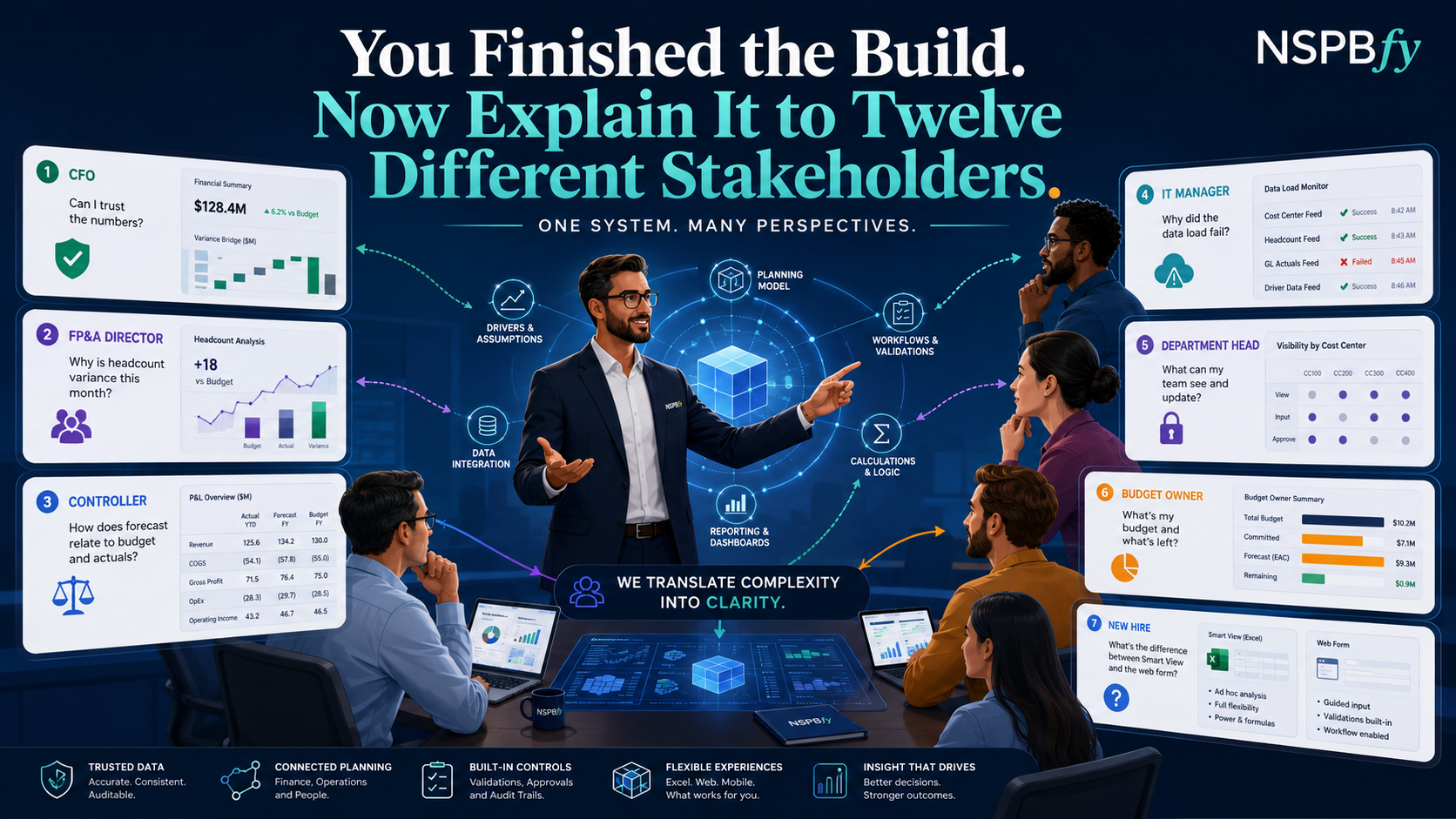
The CFO wants to know why the headcount numbers look different from what HR reported. The FP&A director wants to understand why the Forecast scenario doesn't roll up the same way Budget does. The controller wants to know if the balance sheet drivers are linked to the P&L or manually entered. The IT manager wants to know how the data load works and what happens when it fails. The department heads want to know why they can only see their own cost centres. The budget owners want to know why their Smart View grid shows a different number than the web form.
Same system. Twelve different questions. Twelve different frames of reference. One consultant.
This is the stakeholder explanation problem — and it's one of the most underestimated parts of an NSPB engagement.
The translation gap nobody prepares you for
NSPB consulting attracts people who think in systems. Dimension intersections, calculation order, sparse versus dense, block creation behavior — this is the vocabulary of someone who understands how the engine works. It's also completely useless in a steering committee meeting.
The gap isn't about dumbing things down. It's about translation — taking a technical design that makes perfect sense in Essbase terms and expressing it in the language of the person sitting across from you, which changes depending on who that person is.
A CFO doesn't want to know that the headcount variance is caused by a FIX statement scoped to the Working version. They want to know if the number is right and why it's different from what they expected.
A department head doesn't want to understand security filters. They want to know why they can see their team's budget but not the company total, and whether that's going to change.
An IT manager doesn't want a walkthrough of Calculation Manager. They want to know what breaks, how they'll find out when it does, and who they call.
Each of these is a legitimate question. Each requires a completely different answer from the same technical foundation. And on most implementations, the consultant who built the system is the only person who can bridge that gap — which means they spend a significant portion of the post-build phase in conversations that have nothing to do with configuration and everything to do with communication.
Why this is harder than it sounds
There's an assumption built into most implementation plans that the build phase and the communication phase are sequential: you build the system, then you explain it. In practice they overlap constantly, and the explanation phase never really ends.
During UAT, you're explaining why a number calculated the way it did — which requires knowing not just the rule logic but the business intent behind it, and being able to articulate both simultaneously to someone who understands neither.
During training, you're explaining the same feature five different ways to five different user types, because the way you explain Smart View ad hoc retrieval to an FP&A analyst is not the same way you explain it to a department head who has never opened Excel for anything more complex than a table.
During hypercare, you're explaining why something that worked in testing looks different in production — and the explanation has to satisfy both the technical instinct of the admin and the business anxiety of the finance director who's watching the numbers closely for the first time.
Post-go-live, you're explaining the system to people who weren't in the room during the workshops — new hires, restructured teams, a new CFO who inherited an NSPB implementation they didn't commission and don't fully trust.
The system doesn't change. The audience does. Constantly.
The specific stakeholder translation map
Every NSPB engagement has roughly the same cast of stakeholders, and each one needs a different version of the same truth.
The CFO needs to trust the numbers. They're not interested in how the system works — they're interested in whether the output is reliable. The translation here is: how do you build confidence in the model's logic without walking someone through Essbase calculation order? The answer is almost always showing them the output matches their mental model, then working backward to the design only if it doesn't.
The FP&A Director is the power user and usually the internal champion. They understand financial modeling well enough to ask dangerous questions — "why does this calculate differently than our old Excel model?" is a question that requires both a technical answer and a change management answer simultaneously. They also become the internal trainer and first line of support after go-live, which means they need to understand the system deeply enough to explain it to everyone else.
The Controller cares about the accounting integrity of the model. They want to know that debits and credits behave correctly, that the balance sheet drivers tie to the P&L, that the actuals loading doesn't introduce rounding errors or mapping gaps. Their questions are precise and unforgiving. If you can't answer them confidently, the implementation loses credibility at the most senior accounting level.
The Department Heads and Budget Owners are the majority of end users and the most likely to disengage if the system feels confusing. They don't want to understand NSPB. They want to enter their numbers, see them reflected correctly, and get on with their day. The translation here is ruthless simplification — not of the system, but of what they need to know to use it successfully.
The IT Manager or Systems Admin needs to understand failure modes, not features. What breaks, how often, what the symptoms look like, and what the fix path is. On most mid-market NSPB implementations, IT has minimal involvement in the build — but they become a key stakeholder the first time a Data Load Job fails at 7am and someone needs to escalate.
The New Stakeholder — the one who wasn't there. Six months post-go-live, teams restructure. New people join. A new CFO or FP&A director steps into a system they didn't commission, with design decisions they didn't make, and a rationale they can't access. This is the stakeholder nobody plans for and everyone eventually encounters.
What makes this so expensive
The consultant is the single point of translation for all of this. That's the structural problem.
Every question that can only be answered by "the person who built it" is a question that costs consultant time, creates a dependency that should have been resolved by handover, and represents a gap in the client's ability to operate the system independently.
On a well-run engagement, the translation burden gets distributed over time — the FP&A director learns enough to answer the department head questions, the admin learns enough to handle the technical ones, the CFO builds enough trust in the output to stop interrogating the logic. But that distribution only happens if the knowledge transfers in a form that the client can actually use.
Documentation helps. Training helps. Neither is sufficient on its own, because neither is available at the moment someone needs it — which is usually not a scheduled meeting, it's an unexpected question in an unexpected context from a stakeholder who wasn't in the original training session.
A different way to think about the explanation problem
The best NSPB implementations I've seen share one characteristic: the knowledge of how and why the system was built doesn't live exclusively with the consultant.
Not because the client becomes technically proficient — most don't and shouldn't have to. But because there's an accessible layer between "I have a question" and "I need to call the consultant" — something that can answer "why does this calculate this way" in plain language, specific to their application, available at 8pm on a Tuesday when the budget review is tomorrow morning.
That layer is what we're building in NSPBfy. Not a generic NSPB explainer — there are enough of those, and most of them are wrong about something. A client-specific layer that knows the design decisions, the meeting history, the business rule rationale, and can translate the technical reality of the system into the language of whoever is asking: CFO, budget owner, IT manager, or the new FP&A analyst who just joined and has never seen NSPB before.
Because the translation problem doesn't go away after go-live. It just changes audience.
The last thing to say about this
Consultants who are good at the technical build and bad at the explanation gap don't usually know it — because the system works, the client accepts it, and the problems only surface after rolloff when the consultant is no longer watching.
The ones who are good at both — who can design a clean model and explain it to a CFO, a controller, a budget manager, and a new hire in four different ways without losing the thread — those are the consultants whose clients succeed long-term. Not because they built something better, but because the people using what they built actually understood it.
That understanding doesn't happen by accident. It's designed, documented, and maintained — long after the build is done.
NSPBfy is building the tools to make that understanding accessible — to every stakeholder, at every stage of an NSPB implementation, without the consultant having to be in the room.
© 2026 NSPBfy.com — AI-powered tools for NSPB consultants